About the surgery
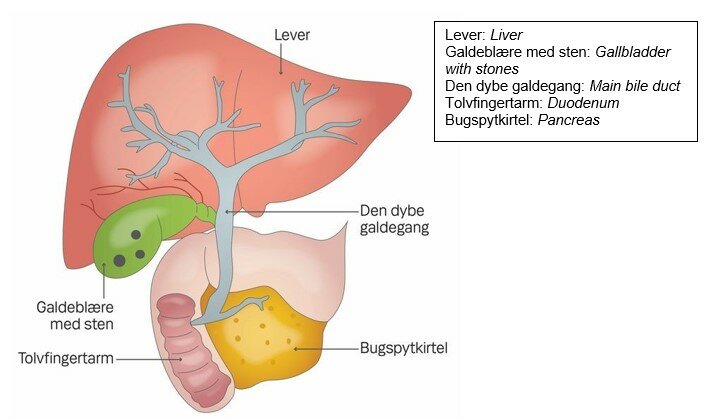
You are going to have your gallbladder removed. This is usually because there is inflammation or stones in the gallbladder or bile duct. The surgery is done under general anaesthesia. Gallstones always form in the gallbladder and mainly consist of cholesterol and other substances from the bile. Bile is a fluid that contains salts, which help break down and absorb fat from food. It is produced in the liver and flows through the gallbladder and into the intestine. The gallstones remain in the gallbladder, and most people do not notice them. If the stones do not cause symptoms, they do not need treatment.
You can live without your gallbladder, as bile will still be produced in the liver and can flow directly from the liver to the intestine through the main bile duct.
There may be waiting time
We cannot give you an exact time for your surgery, but we will do our best to keep you informed. Because we receive emergency patients around the clock and only have one operating theatre for emergency surgery, the order of procedures may change at short notice. The order is decided by the doctors. Therefore, please be aware that there may be waiting time, and your surgery may be delayed.
Important preparation
You must fast before your surgery
You must not eat or drink before your surgery. This means:
- Stop eating 6 hours before your surgery.
- Stop drinking milk products and juice with pulp 6 hours before your surgery. Do not use milk in your coffee or tea either.
- Stop drinking all types of cold and hot drinks 2 hours before your surgery. We recommend that your last drink should be a large glass of squash (sugary concentrate diluted with water) 2 hours before your surgery. The sugar helps prevent nausea and feeling unwell.
We will help you with the exact timing. If you do not follow the fasting instructions, your surgery will be cancelled.
Please tell us if you have diabetes, as special precautions apply.
Remove hair
Before the surgery, you need to remove any hair on your abdomen. You must use a trimmer, which we will lend you. We will explain how to use it. Do not use a razor, as it can cause small cuts in the skin and increase the risk of infection.
Remove nail polish and jewellery
During the surgery, we will place a monitor on one of your fingers to measure the oxygen level in your blood. For this reason, you must remove nail polish and artificial nails before your surgery. You can borrow nail polish remover in the ward. You must also remove your watch, jewellery and piercings. You are welcome to bring your glasses, hearing aid and dental prosthesis to the operating theatre. If you wear contact lenses, you must take them out before the surgery.
Take a shower
We recommend that you take a shower before the surgery. As a minimum, you must clean your navel using a cotton bud, which we will provide.
You will be given clean hospital clothes before the surgery. You are not allowed to wear your own clothes or underwear.
Brush your teeth
Before the surgery, you must brush your teeth thoroughly. We will give you a toothbrush and toothpaste.
We will give you pain relief and blood-thinning medicine
Shortly before you are taken to surgery, you will be given preventive pain relief medicine. You must take it with as little water as possible.
To prevent blood clots, we will also give you an injection with blood-thinning medicine in your thigh. You will also be given compression stockings.
You will have a cannula inserted
We will insert a cannula in your hand. This is used to give you anaesthetic and contrast fluid. The contrast fluid helps highlight the organs so we can see them more clearly during the surgery.
The surgery
You will have general anaesthesia
The surgery is done under general anaesthesia, so you will be asleep and feel no pain.
The surgery
Once the anaesthetic has taken effect, we will make 4 small cuts in your abdomen and insert a camera into the abdominal cavity. During the procedure, we use contrast fluid and inflate your abdomen with air to get a better view. This may feel like pressure in your stomach. The gallbladder and its stones are removed, and the cuts are closed with stitches.
After the surgery
Waking up after the surgery
When the surgery is finished, we will take you to the recovery unit, where you will wake up from the anaesthetic. In the recovery room, you will be connected to equipment that monitors your heart rate, blood pressure and temperature. Most people feel tired and need to rest, but short visits are allowed, subject to agreement with the nurse.
The anaesthetic may cause nausea
You may feel sick or vomit because of the anaesthetic. If needed, we can give you medicine to relieve the nausea.
You may eat and drink after the surgery
We will offer you something to eat and drink when you return to the ward.
We will talk to you about the surgery
After the surgery, we will explain how it went.
You may have shoulder pain
After the surgery, some people experience pain in the right shoulder. This is because air was pumped into the abdominal cavity during the procedure. The air can irritate the diaphragm, which may feel like shoulder pain. This is normal and will go away on its own after a few days. The more you get up and move around, the faster the pain will disappear. A heat pad can also help relieve the pain.
Move around after the surgery
You should get out of bed and start moving as soon as possible after the surgery. This will help you recover more quickly and reduce nausea and the risk of complications.
You will be discharged
Most people are ready to be discharged on the same day as the surgery. You are ready if you:
- do not have nausea or significant pain
- have eaten and drunk
- have passed urine without any problems
- have been informed about what to watch out for at home.
At home
The following section tells you what to watch out for when you are back at home.
Discomfort or pain
Continue taking pain relief
You should continue taking pain relief as long as you are in pain. For most people, this is about 3 days. We recommend that you take the medicine at fixed times for 3 days after the surgery:
| Time: | 8:00 | 12:00 | 15:00 | 17:00 | 22:00 |
| Paracetamol 500 mg - 2 tablets | X | X | | X | X |
| Ibuprofen 200 mg - 2 tablets | X | | X | | X |
Do not take ibuprofen if you have chronic bowel disease (Crohn’s disease), have had a stomach ulcer, or if your own doctor advises against it for other reasons.
In some cases, you may need stronger pain relief, which you will receive to take home from the hospital.
You may get a lump or bruising near the wound
If you develop a lump and pain near the wound within the first 24 hours, it can often be relieved by applying an ice pack and pressing gently on the area for about 30 minutes. If that does not help, you can call us.
The skin around the wound may turn blue due to minor bleeding under the skin. This is not dangerous and will go away on its own within 2-3 weeks.
Care and hygiene
Eat and drink as usual
After the surgery, you may eat and drink as you normally do.
Only take showers
After 24 hours, you may take a shower. However, you must avoid swimming in the sea, taking a bath or going to a swimming pool for the first 10 days, as this increases the risk of infection.
Use a plaster if needed
You do not need to wear a plaster when you return home. If there is fluid coming from the wound, you can apply a plaster. You can also use a plaster if you feel the need for other reasons. If you use a plaster, you must change it every day and if it gets wet.
Avoid constipation
If you have not had a bowel movement 2–3 days after the surgery, we recommend that you take 2 tablets of Magnesia before going to bed. Magnesia is available over the counter. Remember to drink plenty of fluids – ideally 1½–2 litres per day – and to stay as active as possible. If you get diarrhoea, you must stop taking Magnesia.
Take your usual medicine after the surgery
If you were taking regular medicine before the surgery, you can continue taking it as usual.
Help your body recover
After your surgery, movement, diet, smoking and alcohol all play an important role in how quickly you regain your strength and how well your wound heals.
You can read about how to support your recovery at www.bispebjerghospital.dk/patientguiden (in Danish only). Search for 'livsstil' (lifestyle).
Movement and rest
Return to your daily activities
When you return home, you may resume your usual daily activities and move around as you normally do. Listen to your body and take a break if you feel pain that is not relieved by your pain medicine.
Avoid heavy lifting
You must avoid heavy lifting until your stitches have been removed.
Resume sexual activity when you are ready
You can resume sexual activity when you feel ready and have the energy. It will not harm you, but listen to your body if you feel pain around the wound.
Practical information
Important precautions for the first 24 hours
After having general anaesthesia, there are some precautions you must follow during the first 24 hours. Please note that you:
- must not drive a car or other vehicles
- must not operate machinery
- should not drink alcohol.
Sick leave
Whether you need sick leave depends on your individual situation. If you do need sick leave for a period, you can get a sick leave notice from your own doctor.
Follow-up appointment
If we assess that you need a follow-up, you will receive an appointment via Digital Post or regular post. At the follow-up, we will talk to you about your continued care.
When to seek medical attention
Contact us if you notice signs of infection (Open phone contact)
During the first 3 days after the surgery, you can contact Kirurgisk Modtageafsnit KMO (Surgical Admissions Unit (KMO)) directly without calling your own doctor first. We call this open phone contact. Please contact us if you experience:
- redness, warmth, swelling or tenderness around the wound
- increasing pain
- a temperature above 38°C
If it happens more than 3 days after the surgery, please contact your own doctor or call the emergency helpline 1813 outside your doctor’s opening hours.